SmartScratcher
An Examination of the Highest Tier
✦ ✦ ✦

The $100 Club

The fanciest ticket at the gas station — and the six weeks one Oklahoma game flipped the odds on its head.

✦ ✦ ✦
April 28, 2026·10 min read·SmartScratcher Investigates
— Cordially Invited —

There's a kind of scratch-off ticket so unusual that most cashiers have to unlock a drawer to grab one. It doesn't come on a roll. It comes in a small protected case. And it costs as much as dinner for two.

Welcome to the $100 Club. Black tie not required, but you might feel like wearing one. Most of the lottery world plays out at the $1, $5, and $10 level — that's the open-bar crowd. But up here, in the $100 corner of the rack, the tickets are bigger, the prizes are bigger, and the way the math works is genuinely different.

It's a small club. It doesn't exist in every state. The members behave differently than their cheaper cousins. And on at least one well-documented run in Oklahoma, the math at the door briefly — and very quietly — flipped from the house's side to the player's side. For about six weeks. Until somebody noticed.

What follows is a tour. Mind the velvet rope.

✦ ✦ ✦
— Part One —

The Guest List

$100 scratch-offs aren't sold everywhere. Across the three states SmartScratcher covers right now, here's the lay of the land:

Texas
Charter Member
4
Oklahoma
Member in Good Standing
1
California
Has Not Submitted Application
0

California, for whatever reason, sits this one out entirely. The state that gave us movie stars and Silicon Valley caps its scratch-offs at $40.

It's worth pausing on what a $100 ticket actually is. You're spending more on a single piece of paper than some people spend on a week of groceries. The transaction itself is a little ceremony — the clerk's eyebrows go up, the ticket comes out of a case instead of off a roll, the whole thing takes a few extra seconds. Win or lose, you've at least made the day a little more interesting for everyone behind the counter.

✦ ✦ ✦
— Part Two —

What you get for your hundred

A $100 ticket isn't just a $10 ticket with a bigger price tag. The way these games are built is genuinely different — almost a different species. Think of these as the perks that come with the price of admission:

i.
Better Payback

Cheaper tickets are designed to pay back somewhere around 60–70% of what players spend, on average. $100 games usually pay back closer to 80%. The house's edge is thinner up here. Slightly.

ii.
Fewer, Bigger Jackpots

A $5 game might print dozens of top prizes. A $100 game often has only one or two — but they're usually in the millions. The whole prize structure is top-heavy.

iii.
Smaller Print Runs

Fewer tickets get printed overall, because fewer people are buying them at $100 a pop. That's why a single unclaimed jackpot can swing the math so dramatically near the end of a game's life — there are only so many tickets left for it to be hiding in.

iv.
A Longer Life

The smaller print run sells through more slowly. A $100 game can sit on shelves for a year or more, quietly aging — sometimes well, sometimes badly, almost always interesting.

That last point is where the story gets good. Because when a game sits long enough, with one of its only two top prizes still uncollected, something unusual starts to happen to the average value of each remaining ticket. We've got a real-world example. It comes from Oklahoma. It involves about half a million tickets, two five-million-dollar jackpots, and a strange six-week stretch in fall 2025.

The weeks the math tipped

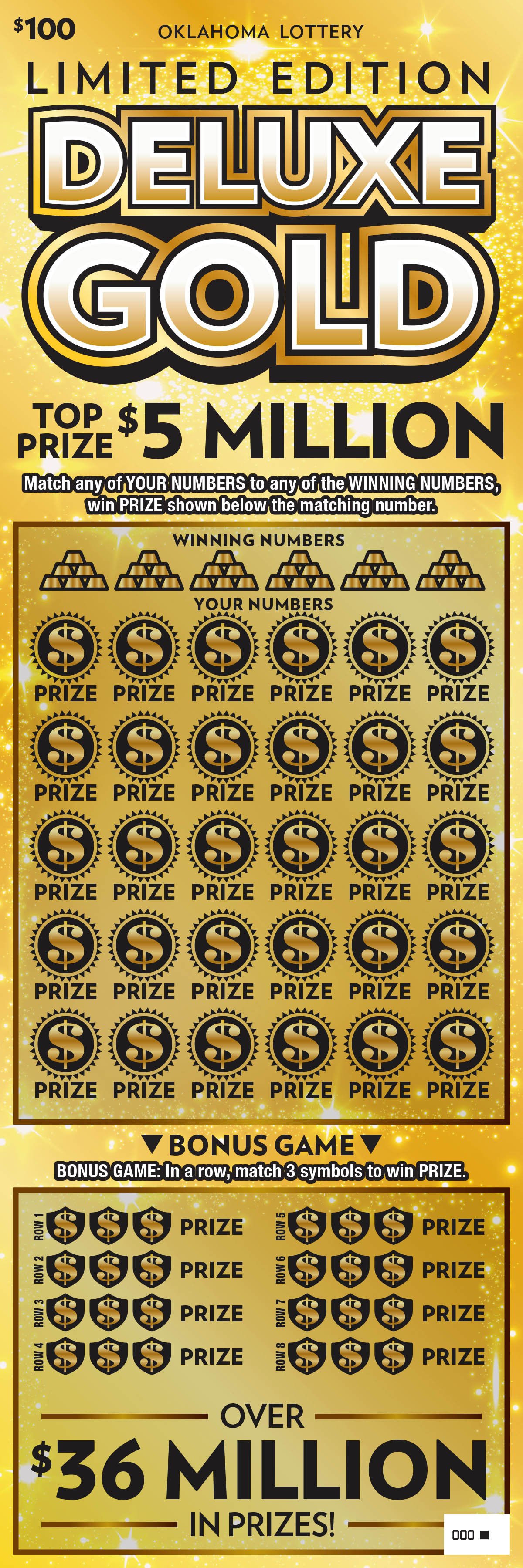
Limited Edition Deluxe Gold. Two five-million-dollar jackpots. Six weeks of climbing odds. One overnight cliff.
Discontinued
Limited Edition Deluxe Gold scratch-off ticket — gold metallic design with $5 Million top prize
— Oklahoma Lottery, Game #689 —
Limited Edition Deluxe Gold
$100 Scratch-Off · 2023 — 2025
Print Run492,204 tickets
Top Prizes2 × $5,000,000
Smaller Prizes$100 — $10,000
Overall Odds1 in 2.64
Launch EV≈ 80
Late-Life EV Peak270

Deluxe Gold launched in early 2023 as Oklahoma's very first $100 scratch-off — a deliberate experiment by the state lottery to see how a premium ticket would sell. Only about 492,000 tickets were ever printed, which is tiny by lottery standards. (For comparison, Texas's first $100 game printed over ten million.) Two top prizes of five million dollars each. A long tail of smaller prizes starting at $100.

The game sold steadily but slowly through 2023, 2024, and into 2025. As tickets got sold and prizes got claimed, something started to shift. The smaller prizes — the $100s, $500s, $1,000s — got picked off at the steady rate they always do. But neither of the two five-million-dollar top prizes had been claimed yet. With fewer and fewer tickets left, and the big prizes still hiding in there somewhere, the average value of each remaining ticket kept climbing.

This is the number SmartScratcher tracks every day. The app calls it Estimated Value, or EV for short. The simplest way to think about EV: if you bought every single ticket left in the game, what percentage of your money would you get back, on average? A fresh game usually starts with an EV around 80, meaning you'd get back about 80% of what you spent. Anything above 100 means you'd get back more than you put in — and that's the line where the math has tipped in the player's favor. Most games never go anywhere near it.

By summer 2025, Deluxe Gold's EV had crossed the 100 line. Somebody had been watching. In August, the first of the two jackpots was claimed by a Pennsylvania-based LLC that had quietly bought a batch of Deluxe Gold tickets in Oklahoma. (More on them in a minute.) That should have been the end of the story.

It wasn't. Because the second jackpot was still out there, sitting in some unscratched ticket on a shelf somewhere in Oklahoma. And the pile of remaining tickets kept shrinking. By the end of October, only about 23,717 tickets were left from the original print run of 492,204 — and one of them, somewhere in the state, was worth five million dollars.

— SmartScratcher Internal Tracking —

Six weeks of climbing. One day of cliff.

Deluxe Gold's Estimated Value · Sept 22, 2025 — Nov 19, 2025

break-even — EV 100 EV 270 OCT 30 — PEAK jackpot claimed Oct 31 EV 60 EV 300 250 200 150 100 SEP 22 OCT 6 OCT 20 OCT 30 NOV 19

SmartScratcher's daily EV calculation, plotted from publicly available Oklahoma Lottery prize-claim data. The morning the second jackpot was claimed, the EV dropped from 270 to about 60 overnight — a roughly 78% drop in a single day.

To put that climb in everyday terms: when Deluxe Gold first launched, with all 492,204 tickets in circulation, your shot at any single ticket being a jackpot winner was about 1 in 246,102. Pretty grim. By October 30, with one jackpot already gone and only 23,717 tickets left, your shot at any single remaining ticket being the second jackpot had improved to about 1 in 23,717. That's roughly ten times better odds at the same five-million-dollar prize. That's why the EV climbed the way it did.

For comparison: most scratch-off games launch with an EV in the 60s or 70s, and as the better prizes get scooped up early, that number can drift even lower. $100 games are built differently. They almost always launch around 80, and they tend to stay there. If a $100 ticket paid back at the rate of a $1 scratcher, almost nobody would ever buy a second one. The slightly better return is part of why these tickets exist at all.

Estimated Value at Late-Game Peak
EV 270
— October 30, 2025 —

An EV of 270 is, on its face, a wild thing for a game whose whole job is to fund Oklahoma's public budget. So a fair question is: why didn't the state just pull the game off the shelves?

The answer is that they didn't have to. The lottery's profit on Deluxe Gold was locked in the day the tickets were printed. Every ticket already sold was already cash in the state's pocket. The remaining prizes were a fixed pile of paper. A high EV near the end of a game's life doesn't cost the state anything — it just means the leftover prizes were now packed into a smaller pool of tickets. The state had no reason to step in. Whoever bought the next Deluxe Gold ticket might walk out with five million dollars, but the lottery's books would look the same either way.

"

An EV of 270 means: if you bought every ticket left, you'd expect to get back about 270% of what you spent. But almost nobody buys every ticket left. Most people buy one or two.

— Part Four —

Two winners, two stories

By the time Deluxe Gold's EV peaked at 270 in late October, the first jackpot had already been claimed back in August. Only the second five-million-dollar prize was still out there — somewhere in those last 23,717 tickets. The math had been on the player's side for months.

Here's what's interesting: the two jackpots ended up in two completely different kinds of hands. One was won by someone who knew exactly what was happening. The other was won by someone who almost certainly had no clue.

— Jackpot One · August 8, 2025 —
Friendly Enterprise LLC
Pennsylvania-based · claimed in OK

According to Oklahoma News 4, an LLC registered in Pennsylvania quietly bought a batch of Deluxe Gold tickets and walked away with one of the two five-million-dollar jackpots — plus a $10,000 winner and eighteen separate $1,000 winners — for a total of roughly $5,028,000 in a single day. For perspective, the published odds of any single ticket winning $1,000 are about 1 in 2,300. Hitting eighteen of them in one day is, statistically, the kind of thing that doesn't happen by accident — it strongly suggests a coordinated buy involving thousands of tickets at once. And because Oklahoma's public data only reports the larger prize wins, the real total was almost certainly higher than $5,028,000. The same LLC also won close to $1.2 million in Pennsylvania's lottery the year before. Lottery analysts call this "lottery tourism" — groups that watch games across multiple states and travel in to play when the math turns favorable. Somebody, in other words, had been watching the same numbers SmartScratcher watches.

— Jackpot Two · October 31, 2025 —
Ernesto, from Iowa Park, TX
Bartlesville, Oklahoma

According to the Oklahoma Lottery, a man from Iowa Park stopped at a Bartlesville store, bought a single Deluxe Gold ticket on what he later called a whim, and uncovered the second five-million-dollar prize on his very first play spot. No spreadsheets. No travel plans. No advantage-play group. Just a guy, a hundred-dollar ticket, and a moment that paid for a vision-board's worth of life plans.

Two jackpots. Two very different ways to walk away with five million dollars. The first one went to a group running spreadsheets. The second went to a man who'd just stopped in to grab a ticket. Both got paid exactly the same.

It would be easy to draw a clean lesson here and pick a side. Don't. The lesson isn't that the math doesn't matter — the LLC made a few million dollars precisely because they were paying attention to it. The lesson also isn't that luck always wins — Ernesto hitting the jackpot on his very first scratch is the kind of thing that almost never happens. The honest takeaway is more boring than either of those: when the math tilts toward the player, anyone holding a ticket is in slightly better shape than they would have been otherwise. Some people figure that out on purpose. Some people just walk in.

✦ ✦ ✦
— Part Five —

Could you have done what the LLC did?

In theory, sure. In practice, almost certainly not. To pull off what Friendly Enterprise pulled off, you'd need:

— The Fine Print —
What "advantage play" actually requires:
  1. The money to bulk-buy. Hundreds of thousands of dollars, ready to spend in a few days. Most people don't have that lying around. The people who do are usually already running this kind of operation.
  2. The setup to actually do it. People on the ground in the right state, retailers willing to sell that many tickets at once, the logistics of moving them around, and the legal paperwork to claim the winnings as a company.
  3. The willingness to lose real money. An EV of 270 doesn't guarantee anything. You can buy a thousand tickets and never hit the jackpot. A favorable EV only pays off in the long run, and only if you can buy enough tickets to ride out the bad luck along the way.
  4. The right timing. The LLC bought in August. By late October, the EV was even higher — but anyone showing up then would have been competing with both other advantage-play groups and regular buyers like Ernesto.
  5. Plain old luck. Even the LLC, with all their planning, only walked away with one of the two jackpots. The other one ended up with a Texan on his first scratch.

None of this is illegal. It's not even all that rare. Advantage play happens — there are people who do it for a living — and state lotteries know about it. But the basic principle hasn't gone anywhere: some games, every once in a while, drift into territory where the math actually favors the player.

And here's what's more useful for the rest of us: Deluxe Gold, in its late life, was one of the best $100 tickets to ever exist. Anyone who happened to buy one during that stretch was, on average, getting a much better deal than they would have a year earlier. That's not nothing. It's also not a green light to bet the mortgage.

This is the difference between information and prediction. SmartScratcher can tell you the math has shifted. It can't tell you what the next ticket holds. Nothing can. That ticket is a sealed envelope that doesn't know or care what any spreadsheet says.

✦ ✦ ✦
— Part Six —

The part that should bother you

Here's the part of the Deluxe Gold story that doesn't get as much attention as the climb and the cliff. The morning the second jackpot was claimed on October 31, 2025, the EV crashed from 270 down to about 60. Both jackpots were gone. Most of the bigger prizes had been claimed too. There was almost nothing of real value left in the remaining pile of tickets.

And Oklahoma kept selling them. The state lottery did not pull Deluxe Gold from store shelves when the second jackpot was claimed. The game stayed in stores all over the state, for two more months, until it was finally retired on December 30, 2025.

People kept buying them. Slower than before, but they kept buying. Regular folks were still walking up to gas station counters and handing over $100 for a ticket whose two top prizes were already gone — on a game with no real shot left at any kind of life-changing payout. There's no judgment in that. Most of those buyers had no way of knowing. The state doesn't put a sticker on the ticket case that says "both jackpots gone, nothing big left to win." The case looked the same as it did in October. The clerk handed it over the same way. The price was the same.

This is the everyday reason an app like SmartScratcher exists. It's not really about catching the next Deluxe Gold–style climb to ride up. The LLC found that one without an app. The honest, day-to-day reason the app exists is to keep regular people from being the November buyer — the one spending $100 on a ticket whose actual value is closer to $60, on a game whose meaningful prizes are already gone.

That's not a wild edge case. That's what scratch-off games look like all the time, in every state, at every price tier. Most "dead" games are way quieter than Deluxe Gold. They don't make the news. They just hollow out slowly until the state retires them. And in the meantime, regular people are still buying them.

Knowing the difference between a game in its prime and a game that's been picked clean is the whole point.

✦ ✦ ✦
— A Final Note from the Door —

The house still wins the season.

Whatever happens with any single game, in any single state, in any given autumn — the lottery's job is to be a profitable engine that funds public programs. It does that job extremely well. The state's profit on a given game is locked in long before the first ticket is scratched. Across every game in every state, the math always, always favors the house in the end.

A $100 ticket whose EV briefly hit 270 is a small statistical curiosity, not a crack in the foundation. The crack closed the moment the second jackpot was claimed. Look at the chart again — the cliff is not subtle.

What changes, ticket to ticket and week to week, is your information.

— Members Only —

Don't be the November buyer.

SmartScratcher tracks every active scratch-off in Oklahoma, Texas, and California, every day. We tell you which games still have real prizes worth chasing — and which ones have been picked clean. Free to browse. Premium for the full picture.

Download on iOS Free tier available · Premium $2.99/month with 3-day free trial